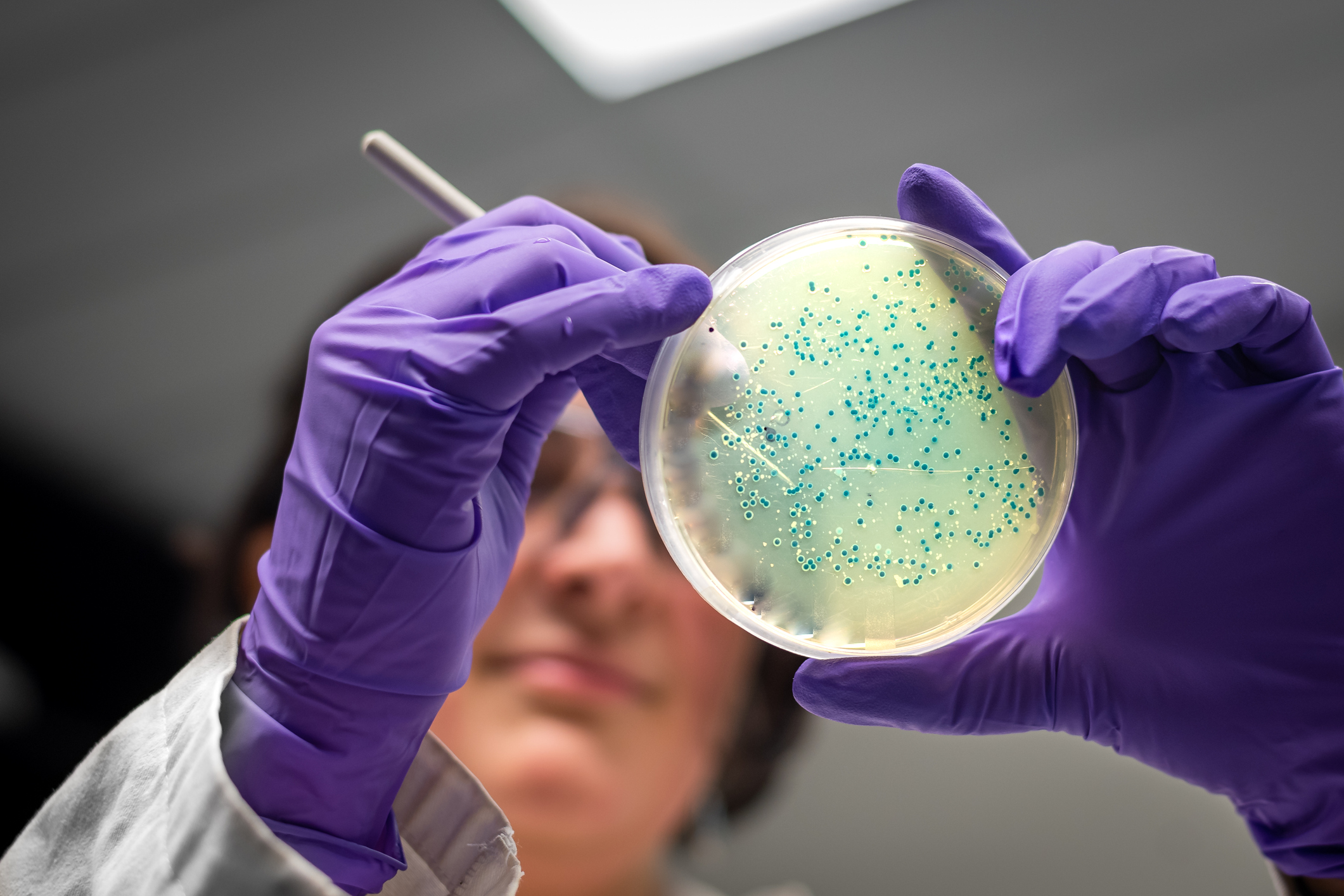
When bacterial pathogens enter our bodies, they鈥檝e got one goal鈥攈unt for food to multiply. And during the process, they make us sick.听

Inside the Skaar Lab, Eric Skaar, Ernest W. Goodpasture Professor of Pathology and director of the Vanderbilt Institute for Infection, Immunology and Inflammation, is uncovering how pathogens compete with healthy microbes for essential nutrients, including manganese and zinc. To protect us, our immune systems tuck these precious metals out of reach, and what we eat might influence the process.听
Drug-resistant bacteria represent one of the greatest threats to public health.听听
鈥淥ur work is focused on identifying new drug targets, and new drugs, to treat these antibiotic-resistant infections,鈥� Skaar said.听
Skaar’s lab studies the interaction between vertebrate hosts (organisms with backbones鈥攈umans, dogs, birds, etc.) and a specific set of bacterial pathogens: Staphylococcus aureus (the most common cause of skin and soft tissue infections), Bacillus anthracis (the causative agent of anthrax), Acinetobacter baumannii (an emerging cause of pneumonia and wound infections) and Clostridium difficile (a major cause of antibiotic-associated diarrhea). 听
His team is credited with advancing understanding of how the immune system fights infection using 鈥渘utritional immunity,鈥� a process that blocks bacteria from accessing the metals they need to grow. These insights could help identify new therapeutic targets to treat bacterial disease.听
For his work highlighting the molecular tug of war over nutrients inside the body during infection, the University Distinguished Professor, vice chair for research and director of the Division of Molecular Pathogenesis in the Department of Pathology, Microbiology and Immunology was recently elected a member of the National Academy of Sciences鈥攁n incredible honor reserved for the nation鈥檚 most distinguished scientists and their contributions to scientific research. Additionally, Skaar received the 2025 NAS Award in Molecular Biology this past spring. 听
鈥淚t is such an incredible honor to be elected to the NAS,鈥� Skaar said. 鈥淢y immediate thought was one of disbelief, followed by gratitude, followed by responsibility. The primary role of the academy is to provide independent, objective advice to the nation on matters of science and technology. I look forward to the opportunity to serve in this capacity and to advocate for microbiology research and for the development of therapies to tackle the antibiotic resistance crisis.鈥�听
Skaar鈥檚 obsession with what makes bacteria tick (and people sick) began in a microbiology class at his suburban Chicago high school.听
鈥淚 was immediately captivated by the amazing world of microbes, and I have never looked back,鈥� Skaar said.听
Today, he and his team are busy piecing together discoveries that could lead to novel therapies to treat microbial diseases.听
鈥淚 like to solve puzzles, so I plan to continue solving puzzles about how bacteria grow inside our bodies and make us sick,鈥� Skaar said. 鈥淢y hope is that discoveries made by our group will lay the groundwork for new classes of antibiotics that target bacterial nutrient acquisition and treat antibiotic-resistant infections.鈥� 听听