When Nashville native discovered his first comet in 1881 that would later be named for him, he was already well known for what we now call 鈥渟tar parties,鈥� inviting people to look through his telescope鈥攚hich cost about two-thirds of his annual salary one year鈥攐n the roof of a three-story building at Fourth and Union streets. Essentially self-taught, Barnard, who took charge of the Vanderbilt Observatory (which was where Rand Terrace now stands) in 1883, became one of the most sought-after observational astronomers of his time, discovering numerous comets, double stars, nebulae, and even a galaxy, as well as becoming a key pioneer in astrophotography.
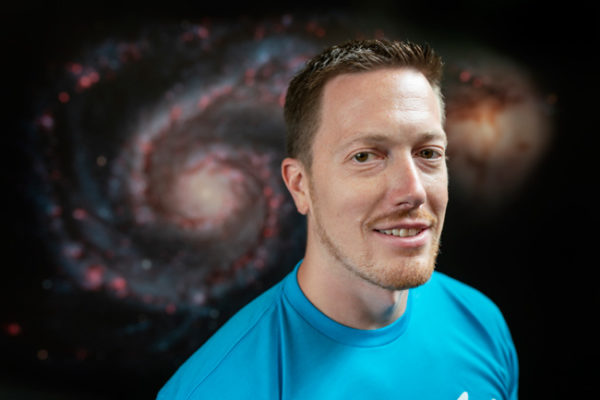
According to William K. “Billy” Teets, PhD鈥�12, director of the current , 鈥淏arnard鈥檚 friends knew that if there was a social function, he would join them if it was a cloudy night. But if it was clear, he was going to be at his telescope from dusk until dawn.鈥�
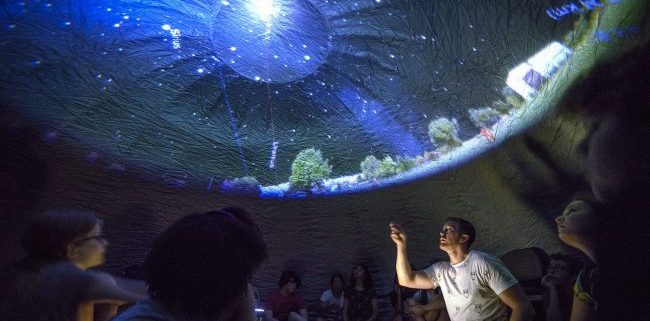
Barnard鈥檚 delight in the stars lives on at , as does his tradition of outreach. Since its dedication in 1953, Dyer has educated Middle Tennesseans about the wonders of the universe from its location on a high hill near Radnor Lake State Park, 10 miles south of campus. At its inception, Dyer was the only graduate research observatory in the Southeast. Because the Nashville community played such a large part in its construction, the observatory was also committed to serving the public from day one.
These days, the city has grown up around Dyer. However, the observatory maintains a busy schedule as a part of Vanderbilt鈥檚 Division of Government and Community Relations, offering partnerships with Metro Nashville Public Schools, summer camps, observing nights for the public to view the sky through its telescopes, Meet the Astronomer lectures and, for the past 20 years, Bluebird on the Mountain concerts to name a few events. Future plans include remounting the six-inch Cooke Telescope used by Barnard at Vanderbilt Observatory in the 1880s for public use.
鈥淚t鈥檚 part of the of scientific instruments and was restored in 2007 by Professor Bob O鈥橠ell [Distinguished Research Professor at Vanderbilt鈥檚 Department of Physics and Astronomy],鈥� Teets says. 鈥淒espite it being about 150 years old, it鈥檚 still in great shape.鈥�
It鈥檚 not just , it鈥檚 the 100th anniversary of Barnard鈥檚 passing and the 70th anniversary of Dyer Observatory. To mark these milestones, Teets offers his advice on how to become as passionate about the stars as E.E. Barnard.
1. Look up and learn.
Specialized equipment isn鈥檛 needed to appreciate the sky. Barnard began by looking up at the sky using his naked eye and paying attention to the movements of its bodies. Dyer鈥檚 website has many links to help identify what you see, including how to spot satellites and the International Space Station.
鈥淚 highly recommend that folks learn the names of bright stars and the constellations,鈥� Teets says. 鈥淓ven if you don鈥檛 know where any of the nebulae or galaxies are, it鈥檚 fun to be able to tell someone, for example, 鈥楽ee that little square of stars there? That鈥檚 the body of the constellation Hercules.鈥欌��
For some astronomical phenomena, the naked eye is better than a telescope. 鈥淢eteor showers are one of those times where you don鈥檛 want a telescope,鈥� Teets says. 鈥淯sing a telescope to watch a meteor shower would be like watching the July Fourth fireworks by looking through a straw. You want to be able to see as much of the sky as possible.鈥�
2. Dark skies are best.
To see more stars, get away from places with a lot of concentrated ambient light, like cities. 鈥淲hen you have all those lights shining, the light scatters in our atmosphere, creating a glow that is unfortunately much brighter than the Milky Way,鈥� Teets says. Getting out into the country is best for seeing the most the sky has to offer. But those observing in the city are not without hope. 鈥淵ou might not see faint galaxies and nebulae, but the moon, planets, and many double stars are all visible鈥攅ven in town.鈥�
3. Telescopes are only as good as the user.
If you decide to buy a telescope, bigger is better. Larger lenses and mirrors gather more light, making fainter objects brighter and providing finer resolution. Don鈥檛 start by buying a computerized telescope, as it adds dramatically to the cost and complicates setup. 鈥淵ou need to understand the motions of the night sky to align a telescope correctly,鈥� Teets says. 鈥淚f it鈥檚 not set up properly, that computerized base is not going to help you.鈥� Using a non-computerized telescope forces you to learn the night sky, he says, 鈥渁nd you have a greater feeling of satisfaction when you finally find that object you just spent five minutes looking for.鈥�
听
4. Don鈥檛 forget the sun!
Safety is key when looking at the sun, and there are relatively inexpensive solar filters that mount to the front of telescopes that make sunspots, which change in size and location daily, safe to view. Teets warns against solar filters that fit in the eyepiece. 鈥淭hose are dangerous because you鈥檙e getting the full intensity of the sun focused into that tiny filter, and they鈥檙e notorious for cracking under heat stress. Any light coming through that crack can damage your eyes.鈥�
On April 8, 2024, a will be visible in Nashville and Middle Tennessee. All you need to view them are those funny glasses everyone had for viewing the total solar eclipse in 2017. 鈥淭hey鈥檙e inexpensive,鈥� Teets says, 鈥渁nd they can give you some of the most pleasing wide-field views of the crescent sun against a jet-black sky. It鈥檚 really breathtaking.鈥�
Learn more about how Dyer Observatory is planning for the 2024 solar eclipse >>>
听
Find out more about the history of Dyer Observatory and its many events, join its mailing list and study its online resources at .
Text by Bonnie Arant Ertelt; photos by Joe Howell/Vanderbilt University