by Ann Marie Deer Owens
Chancellor Daniel Diermeier recently shared the manuscript for his forthcoming book on corporate reputation with a small group of faculty whose diverse areas of expertise reflect the cross-disciplinary approach of his academic research. Reputational Analytics, which builds on Diermeier鈥檚 influential scholarship on reputational risks for global corporations, is scheduled for publication in spring 2023.
Nine faculty members from disciplines that include psychology, political science, law, economics, finance and management offered their informed perspectives on Diermeier鈥檚 work-in-progress during a March 4 conference that was organized by , Ginny and Conner Searcy Dean of the College of Arts and Science, and , Ralph Owen Dean of the Owen Graduate School of Management. The event was held at E. Bronson Ingram College.
Dr. 聽served as moderator and set the stage for a spirited discussion. 鈥淚n this book, Chancellor Diermeier dissects the components of one鈥檚 reputation with the use of trans-disciplinary tools such as cognitive psychology, game theory and other technologies in public policy and political science to address the facts that determine one鈥檚 reputation and adversely or positively influence it,鈥� Churchwell said. 鈥淭he book also examines behavior, beliefs and elements of trust and moral evaluations to understand how institutions maintain, grow and sustain their reputations…The book is truly an intellectual tour de force.鈥�



Diermeier, who holds dual university distinguished professorships in the College of Arts and Science and the Owen School, provided a broad overview of the manuscript, which expands upon his previous books that include Reputation Rules: Strategies for Building Your Company鈥� s Most Valuable Asset.
The new work has twin purposes: to develop a coherent view of corporate reputation that can inform practice and to demonstrate a list of methodologies and show how they can be useful, even essential, in expanding knowledge on corporate reputation. 鈥淭hat is the 鈥榓nalytics鈥� part in the book鈥檚 title,鈥� Diermeier said.
Diermeier defines corporate reputation as public opinion for companies. However, public opinion for corporations involves many more constituencies than public opinion in political science, which is generally limited to the electorate. 鈥淧ublic opinion of corporations involves not only customers, but also shareholders, social activists, politicians and others,鈥� Diermeier explained. 鈥淭herefore, you cannot just use the tools of political science and import them. I draw from a variety of disciplines, including cognitive psychology, psychology and consumer behavior, political communication and media.鈥�
Diermeier鈥檚 research has included extensive discussions with executive CEOs and board members whose greatest management concerns have been people and reputation. 鈥淭here are vast and high-level studies related to employees and performance management, but research on corporate reputation has been much less rigorous,鈥� Diermeier said. 鈥淢y goal has been to use the tools of modern social science to deepen our understanding of the driving forces behind corporate reputation.鈥�
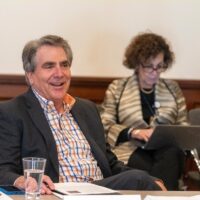
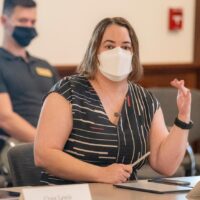
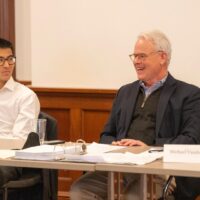
Providing comments and analysis on Diermeier鈥檚 research were:
- Lisa Fazio, associate professor of psychology and human development;
- Allison Anoll, assistant professor of political science and Cornelius Vanderbilt Dean鈥檚 Faculty Fellow;
- Michael Vandenbergh, David Daniels Allen Distinguished Professor of Law;
- Christopher Li, assistant professor of economics;
- Mark Cohen, Justin Potter Professor of American Competitive Enterprise;
- Craig Lewis, Madison S. Wigginton Professor of Finance;
- Larry Bartels, May Werthan Shayne Professor of Public Policy and Social Science;
- Cindy Kam, William R. Kenan, Jr. Professor of Political Science; and
- Alan Wiseman, Cornelius Vanderbilt Professor of Political Economy.