By Andy Flick, Evolutionary Studies Initiative scientific coordinator
If you鈥檝e ever had an ear infection that made you dizzy or unbalanced, the infection likely was affecting your vestibular complex鈥攑art of the intricate system of hard and soft tissues that make up the inner ear. Knowledge of this structure has been made possible through computed tomography scans鈥攊maging technology that continues to shape our understanding of evolution across species.
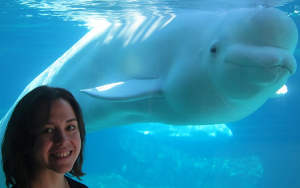
In a review of a century of research on sensory systems of whales, , research assistant professor of biological sciences, describes advances in the field and key questions that remain. The article, 鈥溾�� was published on Sept. 21 in the journal The Anatomical Record.
鈥淎natomy and morphology are areas of research where we are making huge discoveries, especially when we can include fossils to help inform our understanding of evolution, function and convergence that we wouldn鈥檛 otherwise be aware of,鈥� said Racicot, also a faculty member of the . 鈥淭he evolution of sensory systems in whales (and other groups) can be studied using nondestructive CT scanning and other techniques.鈥�
When animals die and become fossils, soft tissues, including those in the ear, break down, and bony areas become scattered with empty pockets where these soft tissues were once housed remain. By recreating these areas digitally, researchers can determine the frequencies animals could hear. One of the questions this technique addresses is whether echolocation evolved independently in different whale groups.
According to Racicot鈥檚 review, it is thought that the first completely marine whales used low-frequency communication, which could travel long distances. Later on, a group of whales evolved higher frequency communication and developed echolocation. In 2019, she discovered that echolocation may have evolved twice and in separate groups of whales.
Whales aren鈥檛 the only animals whose ears are being examined with imaging techniques; researchers are also looking at dinosaurs, birds and other mammals. 鈥淎nother cool study found that cochlear coiling has independently evolved at least twice: once in monotremes (platypus) and another time in therians (live-bearing mammals)鈥攕omething that we wouldn鈥檛 have been able to detect without including fossils in the analysis,鈥� she explained.
Racicot鈥檚 review also acknowledges the open questions about how the whale sensory system has evolved, which are critical to our understanding of the overarching evolutionary trends in ocean-dwelling mammals that have proven difficult to access and study.
This work is already informing and directing the research of Racicot and her trainees. Several undergraduates in her lab are reviewing a data-intensive sample of ziphiid听(beaked whale) inner ears to understand their hearing sensitivities. 鈥淲e can鈥檛 directly measure their hearing ranges easily because they are deep sea diving animals, but there鈥檚 a lot of interest because they tend to strand when naval sonar is used,鈥� Racicot said.
鈥淢any of the big questions we鈥檝e answered using nondestructive imaging like CT scans in studying sensory evolution in whales have led to more questions鈥攚hich means there are so many more discoveries to be made!鈥�