A Vanderbilt team of experts in virology, genetics, structural biology, chemistry, physiology, medicine, immunology and pharmacology have together developed technology to understand and predict animal susceptibility to SARS-CoV-2, the scientific name for the strain of coronavirus causing COVID-19 providing evidence that horses and camels may be at increased risk of the virus. 聽The group has also released a publicly available tool to enable people to understand the likelihood of other animals鈥� susceptibility.
The article, 鈥淧redicting susceptibility to SARS-CoV-2 infection based on structural differences in ACE2 across species,鈥� was in the Federation of American Societies for Experimental Biology (FASEB) Journal on Oct. 5.
The investigators applied a combination of sophisticated genetic sequence alignment and structural analysis of ACE2, the receptor protein for SARS-CoV-2, to a variety of known susceptible and non-susceptible species. Through the analysis they identified five particular amino acid sites within the protein that distinguish virus susceptibility or resistance, and using these sites developed an algorithm to predict susceptibility of unknown species. The algorithm has been made public on a where people can upload the aligned ACE2 sequence of animals with unknown susceptibility to generate a COVID-19 susceptibility score.
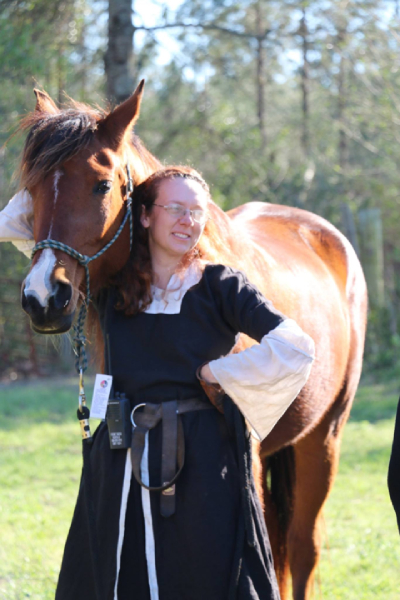
Jacquelyn Brown, a staff scientist at the , initiated the project. 鈥淲hen I first learned that COVID-19 had crossed the species barrier into cats and dogs, I became worried about other animals that might act as reservoirs for the disease or be at risk,鈥� explained Brown, an avid equestrian who practices medieval mounted archery. 鈥淪ince MERS infects camels, I was concerned about what would happen if my horse could get it?! Horses have massive lungs and a sensitive respiratory system, and we humans often touch their noses and mouths.鈥�
live on horse farms and properties in Tennessee and 3.2 million of the state鈥檚 10 million farm acres are devoted to the horse industry. Brown proposed a collaborative research project on the topic to Gordon A. Cain University Professor , who holds appointments in physics, biomedical engineering, and molecular physiology and biophysics.
As the director of VIIBRE, an institute established to foster and enhance interdisciplinary research in the biophysical sciences, bioengineering and medicine at Vanderbilt, Wikswo immediately assembled a trans-institutional team spanning Vanderbilt schools and colleges and Vanderbilt University Medical Center. 鈥淚 speak each discipline鈥檚 language well enough to make the necessary connections,鈥� Wikswo said. 鈥淭his proved to be an outstanding group brought together by their interests and skills that produced an important result in very short order.鈥�
“The project gave meaning to each researcher, at a time when we all were searching for ways to contribute to fighting COVID-19,” noted Wenbiao Chen.
The work could not have been achieved without the collaboration of many researchers. 鈥淭he multidisciplinary approach revealed how much information can be wrung from the same basic information,鈥� noted , the paper鈥檚 co-corresponding author and associate professor of molecular physiology and biophysics. 鈥淲e found potential targets by sequence comparison but wouldn鈥檛 have been able to interpret our findings without structural information. The project gave meaning to each researcher, at a time when we all were searching for ways to contribute to fighting COVID-19.鈥�
鈥淯nderstanding the animals we should more closely scrutinize based on their susceptibility to COVID-19 can help us protect people, pets, wildlife, livestock and our food sources,鈥� said , assistant professor of medicine. The algorithm the team developed is particular to SARS-CoV-2 because it focuses on its particular receptor binding protein ACE2, but the approach is broadly applicable to predicting susceptibility to other viruses or during future outbreaks.
鈥淭here is also the opportunity to investigate if the identified five sites on ACE2 that most distinguish susceptible from non-susceptible species can be used as targets to develop drugs that inhibit these sites specifically. I hope that our results will inspire future research on both rational drug design and closer examination of at-risk species,鈥� said , the paper鈥檚 co-corresponding author, associate professor of medicine and associate director of the at VUMC.
Of note, the work and collaboration were conducted remotely, with an analysis of publicly available data. 鈥淭his experimental approach of using extensive and rapidly accumulating publicly available data in new ways allowed us to efficiently answer a timely question without having to generate new datasets. The collaboration was fun and rewarding, and we were able to answer an important question that none of us could have solved alone,鈥� Alexander, the paper鈥檚 co-first author said. Wikswo pointed out that 鈥渨hile the source data was public, the project required massive calculations of how different versions of the virus would bind to each animal鈥檚 ACE2.鈥�
Members of the collaborative project also include Distinguished Research Professor of Chemistry , , co-first author and postdoctoral scholar, , , graduate student in molecular physiology and biophysics, Chris Moth, computational chemist in the biological sciences department, and Tony Capra, research associate professor of biological sciences.
The work was supported by National Institutes of Health grants F32HL144048-01, DK117147, UH3TR002097 and U01TR002383, U19AI117905, U01AI150739, and R01AI141661, R35GM127087, and DP2HL137166 and American Heart Association grants 20PRE35080177 and EIA34480023