Since the breakthrough in gravitational wave astronomy back in 2015, scientists have been able to detect more than a dozen pairs of closely located black holes鈥攌nown as binary black holes鈥攂y their collisions into each other, due to gravity. However, scientists still debate how many of these black holes are born from stars, and how they are able to get close enough for a collision within the lifetime of our universe.
Now, a promising new study developed by one Vanderbilt astrophysicist may give us a method for finding the number of available stars in the history of the universe that collide as binary black holes.聽
The research, which appears today in , will help future scientists interpret the underlying population of stars and test the formation theories of all colliding black holes across cosmic history.
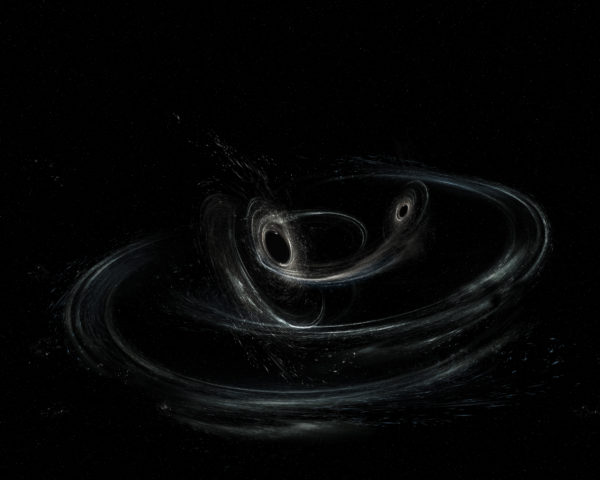
鈥淩esearchers up until now have theorized the formation and existence for pairs of black holes in the universe, but the origins of their predecessors, stars, still remains a mystery,鈥� said Vanderbilt astrophysicist and lead author of the study . 鈥淲ith this study, we did a forensic study of colliding black holes using the astrophysical observations that are currently available. In the process, we developed a fundamental constraint, or budget, which tells us about the fraction of stars since the beginning of the universe that are destined to collide as black holes.鈥�
Leveraging Einstein鈥檚 general theory of relativity, which tells us how black holes interact and eventually collide, Jani and co-author Abraham Loeb at Harvard University used LIGO events on record to take an inventory of the universe鈥檚 time and space resources at any given point. They then developed the constraints accounting for each step in the binary black hole process: the number of available stars in the universe, the process of each star transitioning to an individual black hole, and the detection of the eventual collision of those black holes鈥攑icked up hundreds of millions of years later by LIGO as gravitational waves emitted by the impact.
鈥淔rom the current observations, we find that 14 percent of all the massive stars in the universe are destined to collide as black holes. That鈥檚 remarkable efficiency on nature鈥檚 part,鈥� added Jani. 鈥淭hese added constraints in our framework should help researchers trace the histories of black holes, answering old questions and undoubtedly opening up more exotic scenarios.鈥�
The research is funded by the GRAVITY program at Vanderbilt, and supported in part by the Black Hole Initiative at Harvard University, which is funded by grants from the John Templeton Foundation and the Gordon and Betty Moore Foundation.