An analysis of the microscopic wear on the teeth of the legendary “” reveals that it wasn鈥檛 desperation that drove them to terrorize a railroad camp in Kenya more than a century ago.
鈥淥ur results suggest that preying on people was not the lions鈥� last resort, rather, it was simply the easiest solution to a problem that they confronted,鈥� said , assistant professor of earth and environmental studies at Vanderbilt University.
The study, which she performed with , MacArthur Curator of Mammals at in Chicago, is described in a paper titled 鈥溾�� published online April 19 by the journal Nature: Scientific Reports.
鈥淚t鈥檚 hard to fathom the motivations of animals that lived over a hundred years ago, but scientific specimens allow us to do just that,鈥� said Patterson, who has studied the Tsavo lions extensively. 鈥淪ince The Field Museum preserves these lions鈥� remains, we can study them using techniques that would have been unimaginable a hundred years ago.鈥�
In order to shed light on the lion鈥檚 motivations, DeSantis employed state-of-the-art dental microwear analysis on the teeth of three man-eating lions from the Field Museum鈥檚 collection: the two Tsavo lions and a that consumed at least six people in 1991. The analysis can provide valuable information about the nature of animal鈥檚 diet in the days and weeks before its death.
DeSantis and Patterson undertook the study to investigate the theory that prey shortages may have driven the lions to man eating. At the time, the Tsavo region was in the midst of a two-year drought and a rinderpest epidemic that had ravaged the local wildlife. If the lions were desperate for food and scavenging carcasses, the man-eating lions should have dental microwear similar to hyenas, which routinely chew and digest the bones of their prey.
鈥淒espite contemporary reports of the sound of the lion鈥檚 crunching on the bones of their victims at the edge of the camp, the Tsavo lion鈥檚 teeth do not show wear patterns consistent with eating bones,鈥� said DeSantis. 鈥淚n fact, the wear patterns on their teeth are strikingly similar to those of zoo lions that are typically provisioned with soft foods like beef and horsemeat.鈥�
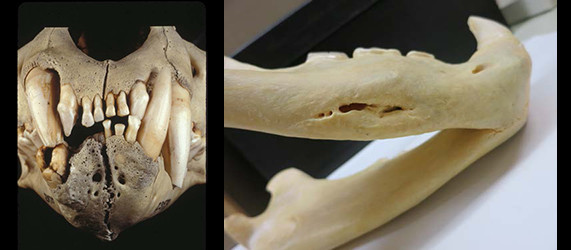
The study provides new support for the proposition that dental disease and injury may play a determining role in turning individual lions into habitual man eaters. The Tsavo lion that did the most man eating, as established through chemical analysis of the lions鈥� bones and fur in a previous study, had severe dental disease. It had a root-tip abscess in one of its canines鈥攁 painful infection at the root of the tooth that would have made normal hunting impossible.
鈥淟ions normally use their jaws to grab prey like zebras and buffalos and suffocate them,鈥� Patterson explained. 鈥淭his lion would have been challenged to subdue and kill large struggling prey. Humans are so much easier to catch.鈥�
The diseased lion鈥檚 partner, on the other hand, had less pronounced injuries to its teeth and jaw鈥攊njuries that are fairly common in lions which are not man eaters. According to the same chemical analysis, it consumed a lot more zebras and buffalos, and far fewer people, than its hunting companion.
The fact that the Mfuwe lion also had severe structural damage to its jaw provides additional support for the role of dental problems in triggering man-eating behavior, as do a number of reports of man-eating incidents by tigers and leopards in colonial India that cite similar infirmities, the researchers pointed out.
鈥淥ur data suggests that these man-eating lions didn鈥檛 completely consume the carcasses of their human or animal prey,鈥� said DeSantis. 鈥淚nstead, people appear to have supplemented their already diverse diet. Anthropological evidence suggests that humans have been a regular item on the menu of not only lions, but also leopards and the other great cats. Today, lions seldom hunt people, but as human populations continue to grow and the numbers of prey species decline, man eating may increasingly become a viable option for many lions.鈥�
The study was funded by Vanderbilt University, the Brown Fund of the Field Museum of Natural History and grant EAR1053839.