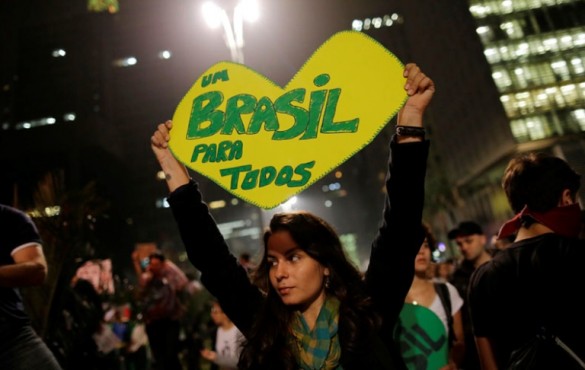
Government officials in Chile, Uruguay and Peru may soon find themselves facing the same kind of protests that Brazil has been weathering this year, based on the similar conditions noted by .
鈥淥ur findings suggest that conditions may be ripe for an outburst of protest in many of the region鈥檚 countries where rising education rates and sustained economic growth combine with low quality political institutions and inferior and sporadic public service provision,鈥� write Mason Moseley and Matthew Layton, graduate research political science students at Vanderbilt, in the report,
The protests in Brazil this year are unprecedented in the recent history of that nation.
More than 2 million citizens are estimated to have participated in ongoing public demonstrations in several Brazilian cities. Initially organized in response to increases in the cost of public transportation, the protests have come to encompass other topics such as police brutality against the demonstrators.
In the 2012 AmericasBarometer Survey by LAPOP, just 41.7 percent of Brazilians were satisfied with 鈥減ublic services,鈥� meaning the combination of quality of roads, schools and public health services. Nearby nations had comparable satisfaction levels, with Chile at 44.3 percent, Uruguay at 50.4 percent and Peru at 46.8 percent.
Likewise, support for the political system in Brazil was at 45.4 percent, with the others coming in at 55.1 percent (Chile), 59.8 percent (Uruguay) and 49.4 percent (Peru).
Protesters in South American countries also now have the benefit of access to social media to aid in organization efforts, which has been a clear game-changer in Brazil.
鈥淭hese findings suggest that across Latin America, the past decade of strong economic growth, advances in education and increased access to social media may portend a new era of protests in countries such as Chile, Uruguay and Peru that have enjoyed similar periods of rapid socioeconomic development amidst high levels of citizens dissatisfaction with public services,鈥� Moseley and Layton write.
LAPOP develops, implements and analyzes the AmericasBarometer public opinion surveys. Since the 1970s, LAPOP has gathered a treasure-trove of databases containing political perspectives from Latin America and the Caribbean. LAPOP data and reports are available to interested researchers at the .
LAPOP was founded by its director , Centennial Professor of Political Science at Vanderbilt University. Its Insights series is co-edited by Seligson, , associate professor of political science, and , associate professor of political science and associate director of LAPOP.