The Ring Nebula鈥檚 distinctive shape 鈥� a circular band of glowing red-orange gas 鈥� has made it one of the most familiar astronomical images.
Now, a team of researchers, headed by Vanderbilt astronomer , has combined images from with images from ground-based telescopes to reconstruct the three-dimensional shape of the iconic nebula with unprecedented precision. In the process, they have determined that it is considerably different than previously thought.
鈥淭he nebula is not like a bagel, but rather, it鈥檚 like a jelly doughnut, because it鈥檚 filled with material in the middle,鈥� said O鈥橠ell in the issued on May 23 that announced the results of the year-and-a-half study. 鈥淸rquote]With Hubble鈥檚 detail, we see a completely different shape than what鈥檚 been thought about historically for this classic nebula.鈥漑/rquote]
The Ring Nebula is located in the constellation Lyra and is about 2,000 light-years from Earth. It was produced 4,000 years ago when a red giant star about three times the mass of the sun ran out of nuclear fuel and collapsed to form a white dwarf star. In the process its outer layers were blown outward to form the nebula.
The study of these nebulae is important because it provides important information about the final stages in the lives of stars. In addition, the nebulae are one of the mechanisms by which the heavier elements, including carbon, oxygen and iron, that are created within stars are spread and recycled throughout the galaxy.
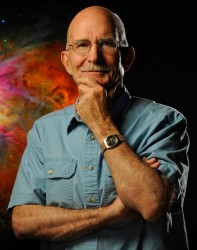
O鈥橠ell and his colleagues 鈥� from the University of Kentucky, and from the 鈥� picked the Ring Nebula because they thought its shape was simple enough to work out its three-dimensional structure.
Telescope images are inherently two-dimensional so adding the third dimension can be quite challenging.
For the Ring Nebula the researchers started with the latest Hubble images and compared them with images made in 1998. This allowed them to determine that the nebula is expanding at more than 43,000 miles per hour and that the material in the center is moving faster than the main ring.
Analyzing the light emissions of individual elements allowed the researchers to map the density and temperature of different parts of the nebula. For example, they used the fact that the spacing between a specific pair of emission lines emitted by sulfur varies with density to get density measurements.
Infrared images obtained by the in Arizona provided them with measurements of molecular hydrogen.
Finally, spectroscopic data of the nebula made at the Mexican National Observatory in Baja California, Mexico, allowed the scientists to map the motions across the face of the nebula. Spectroscopic data breaks white light into different colors. Light from the side moving away from Earth was shifted toward the red end of the spectrum while light from the side moving toward the Earth was shifted toward the blue end.
By combining this information and making some simplifying assumptions, such as that material is moving radially away from the star, the researchers were able to create an accurate three-dimensional model.
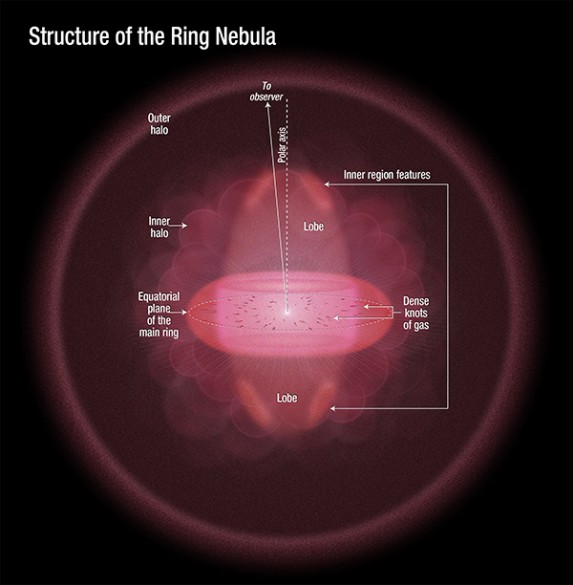
Instead of a simple ring, O鈥橠ell and his colleagues found that the area at the center is shaped like a football with the axis facing Earth. It is filled the helium that glows blue in ultraviolet light from the remnant white dwarf star. This is the hottest region of the nebula and is expanding faster than the outer layers cast off earlier in the process. The green and red regions are caused by light emitted by oxygen and nitrogen ions respectively and are brightest where the hotter gas in the inner layer is colliding with the cooler gas in the outer layers.
The research was supported by NASA grant HST-GO-12309.