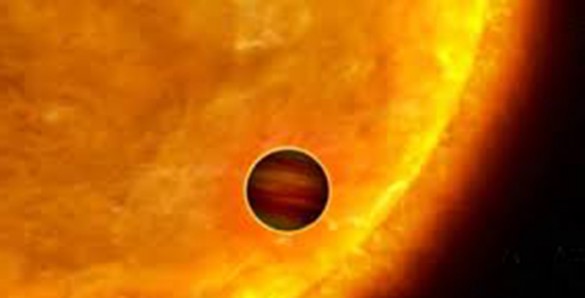
A team of Vanderbilt astronomers headed by will play a key role in the planet-seeking space telescope that has just approved and scheduled for launch in 2017.
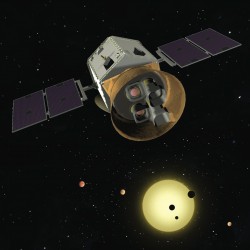
The $200 million spacecraft is called the Transiting Exoplanet Survey Satellite (TESS). When it is launched in 2017, TESS will perform the first space-borne all-sky survey for planets circling the brightest stars.
The project is headed by scientists at . Stassun is a co-principal investigator on the project and he and his team will be selecting the specific stars that the project will target in its search for subtle, periodic dips in brightness that occurs when a planet transits across a star鈥檚 face.
鈥淚 got involved in 2011 during a sabbatical at MIT,鈥� said Stassun, who is a professor of physics and astronomy at Vanderbilt. 鈥淎t the time, one of the issues they were struggling with was how to select the most promising stars to search for planets.鈥�
It was a process he had already worked through for , the Kilodegree Extremely Little Telescope: a pair of small, land-based telescopes built and operated by Vanderbilt and Ohio State University that are designed specifically for identifying bright stars with planets. KELT, as will TESS, simultaneously records the light coming from millions of the brightest stars and so faces a similar selection problem. 鈥淚 was able to tell them that we鈥檝e already addressed the problem. They liked our approach so they invited us to join the mission,鈥� he added.
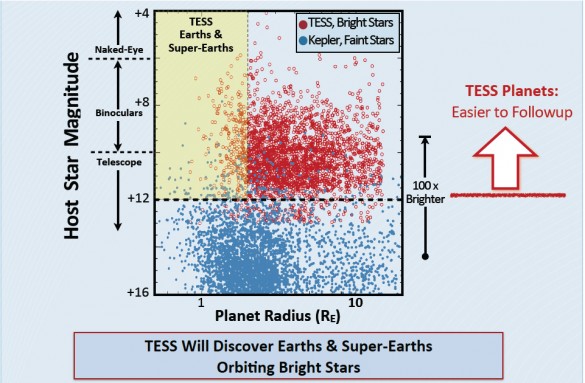
When it is launched TESS will complement the observations being made by Kepler, NASA鈥檚 first mission capable of finding Earth-sized planets around other stars. Kepler was designed to observe much fainter stars than TESS but it is focused on a relatively small portion of the Milky Way galaxy. Three Vanderbilt astronomers, including Stassun, are also members of the Kepler science team. As of last January, Kepler had identified 2,740 candidate planets, which are steadily being confirmed by follow-up observations from other telescopes.
Most of the exoplanets that have been discovered to date are giant planets, like Jupiter. Kepler has discovered a number of smaller exoplanets, closer to the size of Earth. But Kepler has difficulty identifying smaller planets because the stars that it examines tend to be extremely faint, which makes it very difficult to confirm discoveries with ground-based telescopes. TESS, by contrast, is targeting the brightest stars specifically to make it easier to discover Earth-sized planets.
鈥淲e will be targeting mainly G-type stars similar to the Sun,鈥� said Stassun. 鈥淣ot only should concentrating on the brightest stars make it easier to find Earth-like planets, but, once we have found them, it should be possible to use large land-based telescopes to get spectra of the planet鈥檚 atmosphere.鈥�
These spectra are important because they could provide information about the chemical make-up of the planetary atmospheres. If certain chemicals, like oxygen and methane, are detected it would be a strong indicator that a planet is capable of supporting life.
鈥淲e will also target a small number of red dwarf stars (such as which was discovered by Vanderbilt鈥檚 first astronomer) because these are the stars nearest to us. If we are to imagine ever traveling to visit another world, it will be a world around one of these red dwarf neighbors,鈥� Stassun said.