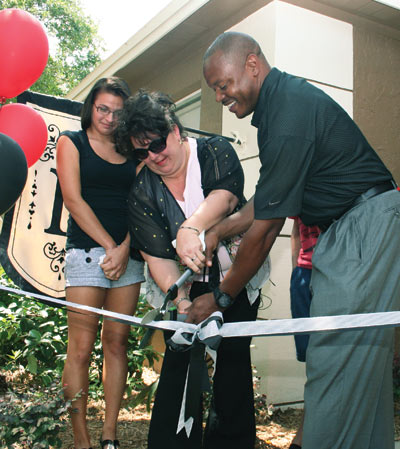
Former linebacker Shelton Quarles coordinates pro scouting for the Tampa Bay Buccaneers. Shaiza Rizavi is a New York portfolio manager who previously worked in international aid and development. Entrepreneur Jeremy Werthan runs a granite company in his native Nashville. Ryan Pickens teaches business at a small liberal arts college in North Carolina.
At first glance, these alumni do not seem to share much beyond their undergraduate major, human and organizational development. They came to Vanderbilt from diverse backgrounds and went on to pursue widely divergent careers. The causes that move them vary, but together they show that there are many different ways to serve community.
Shelton Quarles, BS ’94
As a top college athlete headed toward a pro football career, Shelton Quarles learned how to get things done.
“The demands of being a student and being in a sport—they taught me time management, to be efficient,” Quarles says.
Quarles’ pace did not slow during his 10 years as a linebacker for the Buccaneers, which included multiple playoff seasons and a Super Bowl championship in January 2003. Off the field, he found himself increasingly interested in community service.
“Coach [Tony] Dungy encouraged us to get out in the community, because they support us in such a major way,” Quarles says. “I started out doing a lot of different things—Easter egg hunts, events for the American Heart Association, various community-minded activities.”
In 2004, after several years in Tampa Bay, Quarles and his wife, Damaris, decided to focus their volunteer efforts. They established the IMPACT Foundation, which helps at-risk, single-parent families in the Tampa Bay area.
“My foundation is my passion. It’s near and dear to my heart,” says Quarles, who was born at Vanderbilt University Medical Center and grew up in Nashville. He knows first hand the difficulties single-parent families can face. “I was raised by a single parent,” Quarles says. “[My mom] was 15 when I was born. She’s always been supportive, and we have a great relationship.”
Florida Gov. Charlie Crist then tapped Quarles to chair the new Tampa Bay Area Regional Transportation Authority (TBARTA), established in 2007 to develop and implement a master plan to modernize the region’s transit system. Quarles had just stopped playing football; he was in his first year as a pro scout for the Buccaneers. Some questioned whether a former football player had the right skills to lead critical transportation policy, but Quarles won over the skeptics. By the end of his two-year tenure, the board had created a master plan and presented it in dozens of public forums. Successfully working across a seven-county region to develop potentially controversial, not to mention costly, transportation policy was no small feat.
“At the time it was the most powerful board formed by the legislature,” Quarles says. “I had four mayors, seven county commissioners and three other gubernatorial appointees under my leadership. It was pretty fun. It was a little bit different, though. It was politics.”
Quarles did not seek re-appointment to TBARTA after his first term. He is now the Buccaneers’ coordinator of pro scouting and concentrates his volunteer energy on his labor of love, the IMPACT Foundation. The organization has raised almost $700,000 for its work.
“One of our big programs is called Home Blitz,” Quarles says. “We find a single mother whose home is in disrepair and take the family out of the home for about a month. We add new floors, walls, roofs, landscaping, kitchens, baths—it’s basically a new house without taking the house down. The week of the reveal, we take them to Disney or Universal Studios, and then we bring them home.”
Quarles has a simple message to students wondering what they can do to get involved in their communities: “Just try it. You can always move on to the next thing if you don’t like it. You have to find your niche. But if you say you don’t know what you want to do, you’ll never do anything.”
Shaiza Rizavi, BS ’91

Shaiza Rizavi was only 7 years old when she left Pakistan with her family, but her early memories of Karachi had lasting impact.
“Even in high school, I did a lot of community service, and I think part of the reason is that I came from Karachi,” Rizavi says. “You grow up there, you go into the city and see the poverty, and then you go home and sleep in a nice bed. It’s like the saying goes, ‘from those to whom much is given, much is expected.’”
As a student at Vanderbilt, Rizavi demonstrated her commitment to helping those in need. She worked at public defender’s offices in Nashville and Washington, D.C., with the homeless during Alternative Spring Break, and with a program to improve services for people with family members in prison. After graduation, thinking she might want to become a public defender, she took a job at a New York law firm. It did not suit.
“The work that I’d come from was problem solving: Were people’s needs getting addressed?” Rizavi says. “This job was a lot of paperwork. It wasn’t all that stimulating.”
So Rizavi took a leap. She bought a ticket to Thailand with the intention of finding a job in development once she got there. Soon she was evaluating programs designed to address child labor and prostitution in Thailand, Vietnam and throughout the region.
“So much of life is about risk,” Rizavi says. “It may not be the safest approach, but sometimes you have to explore to get where you’re going. It doesn’t really matter if you get it right or wrong—you can correct things as you go along.”
The work was rewarding, but emotionally difficult. After two years, Rizavi needed a break.
“I was a bit beaten down coming back from Thailand. Seeing life not work out for a lot of those children is hard,” Rizavi says. She returned to New York and entered Columbia Business School.
Today, Rizavi brings her passion for international development to her career as a portfolio manager at Gilder Gagnon Howe & Co., specializing in global securities. The busy mother of four also still finds time for community work. She serves on the advisory board of The Social Enterprise Program at Columbia Business School and volunteers with several local nonprofits.
Pakistan, the country that first inspired her, still holds a place in Rizavi’s heart. She plans to travel there soon and hopes to visit projects supported by the Acumen Fund, a nonprofit organization that uses investment as an international development tool.
Ryan Pickens, BS ’94
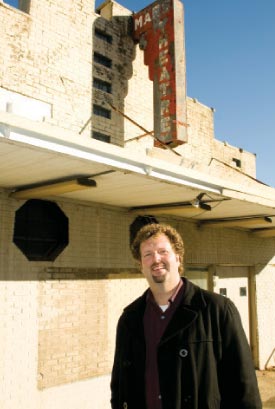
Barely three years after coming to teach business in Mars Hill, N.C.—really a blink of the eye in Appalachian time—Ryan Pickens was coming up with ideas to help revitalize the economically struggling small town.
He bought the empty Mars Hill Theatre on Main Street in 2004. The following year, he purchased the boarding house next door. By 2009, he was running for mayor. He lost the race, 325 votes to 113, but it was a respectable showing considering he does not live in the town full time; he regularly commutes from Asheville.
Pickens, who teaches at Mars Hill College, now is focused on getting financial backing for his , which includes plans for restaurant and entertainment space. He hopes to contribute to the downtown’s revival and create new resources for the college and its students. He describes the project in terms of social entrepreneurism, envisioning a business that creates a modest profit, benefits the community and positively impacts the environment.
Pickens also refers to this in terms of a “triple bottom line”: profit, planet and people.
“It ties into the idea of buying local,” Pickens says, citing a study by the state’s commerce department that showed the area around Mars Hill losing tens of millions of retail dollars each year.
“People are driving to spend money. If you look at that from a social aspect, the community is not getting its needs met inside the community,” Pickens says. “If you look at it from an environmental aspect, people are polluting every time they fire up their cars.”
Pickens credits his parents with inspiring his civic involvement.
“I learned a lot about community service with my parents growing up. We were very involved with a shelter in Atlanta, helping people that were homeless. At one point we opened our own house up and had people living with us,” Pickens says. His father, John Pickens, JD‘71, founded the Georgia Justice Project, which provides criminal defense to the indigent, and now heads up the social justice organization Alabama Appleseed.
He also credits his education.
“My education at Vanderbilt and in human and organizational development helped me understand that organization is about helping people and taking care of people,” Pickens says. “My focus in life and business is about creating community.”
Jeremy Werthan, BS ’94
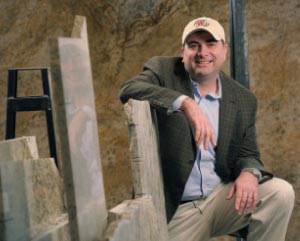
For Jeremy Werthan, philanthropy and service are, quite simply, facts of life. There may be times when you can do more, and times when you can do less, but you always do something.
Werthan learned this from his family, starting as a child.
“You have to get people into this giving philosophy early,” Werthan says. “That’s what happened to me. I learned that it’s just what you do.”
Because he understands the importance of this teaching, Werthan has advocated that Vanderbilt University adopt a service requirement.
“We tried to launch a program, at Peabody especially, that would require community service work,” Werthan says, referring to efforts he made in the late 1990s. “A lot of these people stay here in Nashville. Let’s get them involved. If they don’t get involved now, they won’t. And they have the time now.”
Werthan describes himself as blunt and says nonprofits benefit when people speak up. He points to an experience with the United Way of Metropolitan Nashville as an example.
“I had been giving money to the United Way while I was in college,” Werthan says. “I gave them $500, which was a lot of money to me at the time, and I never heard from them again.”
Werthan thought this was strange. He could not understand why the organization did not take the opportunity to court young donors, as a way of cultivating the next generation of givers. So he called and asked.
In response, the United Way asked if he would help spearhead the creation of what in 1997 became the Sennet Society, which promotes service and giving among young adults interested in community leadership.
“I think it has raised about $5 million,” Werthan says.
Werthan, who has five children and runs his own company, Werthan Granite, has been active in numerous charities over the years. Today he financially supports a range of nonprofits, and sits on the Middle Tennessee Leadership Council for Youth Villages, which provides services for emotionally troubled children and their families. His advice to young people who want to give back to their communities is simple.
“Find what fits for you, what has meaning for you,” Werthan says. “And, unless it will hurt somebody, never hold your tongue.”