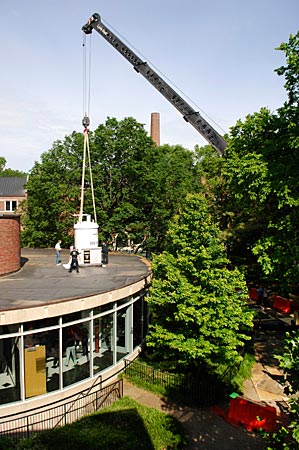
Onlookers cheered on the morning of Saturday, May 7, as a shattering champagne bottle christened the delivery of a $5 million, 7.5-ton magnet to Vanderbilt University.
The magnet is the main part of an ultra-high field, 900 megahertz nuclear magnetic resonance (NMR) spectrometer that will help researchers solve the mysteries of cancer, Alzheimer鈥檚 disease and other disorders.
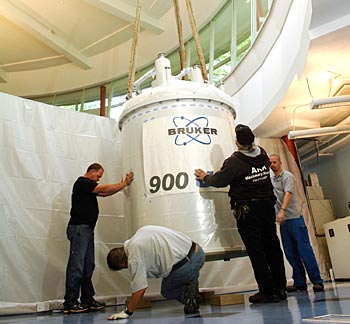
Standing 9.5 feet tall, the nearly 6-foot wide white cylinder was gingerly lowered by crane through an opening in the roof of the — with just 4 inches of clearance.
The arrival of the magnet 鈥渋s a big moment for chemistry and structural biology at Vanderbilt,鈥� said , chair of , who uses NMR to study how DNA is damaged by mutagenic chemicals. 鈥淚 think it鈥檚 going to enable us to do science that is really on the cutting edge.鈥�
The instrument consists of superconducting alloy wire which, when cooled by liquid helium to near absolute zero, has essentially no resistance and therefore can generate an extremely high magnetic field, Stone said.
Once it鈥檚 up and running this summer, it will be one of about 10 such devices in operation the United States. Its application at Vanderbilt to cancer drug discovery may be unique, faculty members said.
The spectrometer鈥檚 high magnetic field leads to the production of detailed 3-D 鈥減ictures鈥� on the molecular level that can reveal the structure of large, complex molecules or of smaller, drug-like molecules binding to disease-related proteins.
In the latter case, this information can help scientists 鈥渙ptimize鈥� the molecules so they bind more strongly and specifically to their targets and have a better chance of becoming new drugs, said , the Orrin H. Ingram II Chair in Cancer Research, professor of , and Chemistry, and leader of Vanderbilt鈥檚 cancer drug discovery program.
鈥淭hink of an old-fashioned watch that has many tiny little pieces,鈥� explained , professor of biochemistry who uses NMR to determine the structure of large membrane proteins associated with human disorders such as abnormal heart rhythms.
鈥淭rying to fix a protein that鈥檚 broken in a disease without knowing the structure is like trying to fix a watch without being able to see (inside),鈥� he said. 鈥淵ou have to be able to see what it is you鈥檙e trying to fix.鈥�
Paul Barrett, a third-year graduate student in , said he hopes the new instrument will enable his group to be the first to determine the structure of C99, a membrane protein involved in the development of Alzheimer鈥檚 disease.
鈥淏y using the new 鈥�900,鈥� we鈥檒l really be able to get some great information on the structure, dynamics and function of this protein,鈥� Barrett said. 鈥淸rquote]It will be a great foundation of knowledge for understanding how Alzheimer鈥檚 disease begins.[/rquote]鈥�
Sanders is principal investigator of a $3.9 million stimulus grant awarded in 2009 by the to buy the spectrometer. The university renovated the circular Biomolecular NMR Facility that houses the instrument, and the medical center covered the remaining costs, said , research assistant professor of Chemistry and the facility鈥檚 director of operations.
Vanderbilt鈥檚 success in obtaining the grant owes a lot to , the Chancellor鈥檚 Professor of Biochemistry and Chemistry, and the 鈥渨orld-class鈥� he directs, Sanders said.
Saturday鈥檚 delivery also exemplifies the university鈥檚 鈥渧isionary leadership,鈥� which is willing to invest in the future, and its collaborative environment, which encourages scientists to work together across disciplines, he and Fesik pointed out.
鈥淭here鈥檚 a really good chance that in 10 years Vanderbilt鈥檚 going to be a leader in taking structural biology information . . . and translating that into therapeutic discoveries,鈥� Sanders predicted. 鈥淎nd that鈥檚 pretty exciting.鈥�