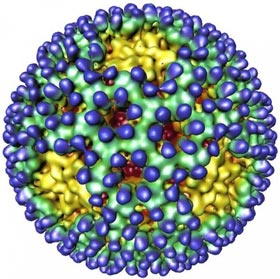
The reovirus family, which includes the human pathogen rotavirus and various livestock pathogens, infects most mammals. Like all viruses, reovirus uses cellular processes to enter host cells and cause infection. The cellular factors that provide reovirus access to the cell interior are not fully defined.
In the , Bernardo Mainou and identify the protein kinase Src as an important mediator of reovirus cell entry. The investigators found that chemical inhibitors of Src kinase diminish reovirus infectivity by blocking an early step in the life cycle of the virus. Reovirus co-localizes with Src during cell entry, and reovirus infection activates Src. They also showed that reducing Src levels limits reovirus infectivity, supporting a role for Src in reovirus cell entry.
Understanding how viruses engage Src and other cellular factors to gain access to the cell interior may foster the development of broadly active antiviral drugs that inhibit key steps in the entry process.
This research was supported by the , the , and the Elizabeth B. Lamb Center for Pediatric Research. Additional support was provided by awards to the from the and to the from the .