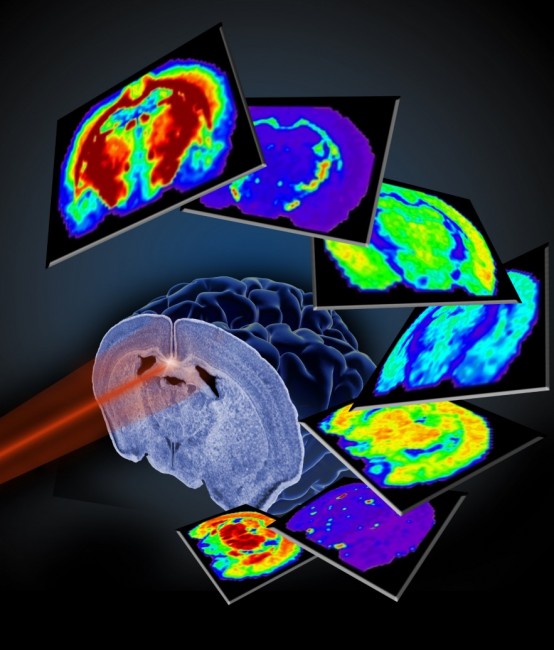
The has awarded Vanderbilt University $10.3 million dollars over the next five years to establish a National Research Resource for Imaging Mass Spectrometry. , director of Vanderbilt鈥檚 , is leading the program.
Imaging mass spectrometry is a tool for visualizing the location of proteins in cells and tissues. It can be used to 鈥渇ollow鈥� the molecular changes that cause disease, which is 鈥渧ital to our understanding of how to treat a patient to stabilize, reverse and even eliminate disease processes,鈥� said Caprioli, the Stanley Cohen Professor of Biochemistry and professor of chemistry, medicine and pharmacology.
Caprioli has pioneered imaging mass spectrometry techniques and expects the new Research Resource to move this technology from the instrumental development laboratory to the biological and clinical research laboratory as a routine imaging tool.
鈥淚maging mass spectrometry gives the research scientist and the physician a new and unprecedented view of the molecular changes underlying disease processes,鈥� Caprioli said.

The National Research Resource for Imaging Mass Spectrometry will focus on developing new technologies 鈥� next generation hardware, software and methods 鈥� for direct tissue profiling and imaging using mass spectrometry. New biological applications will include high spatial resolution imaging of serotonin neurons in neurodevelopmental disorders, studies of cervical and brain cancers, studies of age-related macular degeneration and studies of tumor blood vessel development.
The resource will support short training courses and scientific visits to encourage collaborations.
The molecular view offered by imaging mass spectrometry will offer a new understanding of the biology of health and disease that will lead to novel treatment opportunities for patients, Caprioli said.