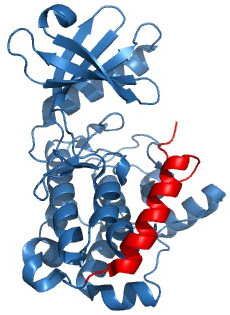
The enzyme CaMKII plays a central role in translating fluctuations of cellular calcium levels into signals that mediate many biological processes – from heart rhythms to learning and memory. The enzyme has three main pieces, or domains, which change shape (conformation) to activate the enzyme.
A more detailed understanding of this shape-shifting is necessary to design therapies targeting the enzyme.
Using molecular “spies” (spin labels) to visualize these changes, , , and colleagues found that the business end (the “kinase” domain) is kept in an inhibited state by the conformational qualities of another domain (the regulatory domain). Binding of calmodulin – a calcium-binding protein that “senses” calcium fluctuations – to the regulatory domain induces structural changes that activate the kinase domain and enhance the enzyme’s interaction with calmodulin.
The findings, , offer a dynamic picture of CaMKII activation which can potentially inform development of new therapeutic strategies for neurological, psychiatric or cardiac diseases.
The research was supported by the Vanderbilt University IDEAS program, a trans-institutional program to foster collaborations at Vanderbilt.